Open your customer's Apple Wallet. Go on, picture it. Somewhere between the boarding pass from a 2023 trip and a cinema ticket they never scanned, there's a little graveyard of loyalty cards - the smoothie place, two coffee shops, a car wash they visited exactly once. Each one joined in a hopeful single tap. None of them opened since.
That picture is the entire wallet-pass-vs-app decision, so let's have it honestly.
Updated 7 October 2026: added a direct answer to the "customers won't download another app" objection with sourced figures, FAQs for barbershops and clinics, and corrected the comparison table, which understated what wallet-pass platforms show the owner.
We build LoyalsClub, which is an app - so be appropriately suspicious of our conclusion and judge the reasoning, not the badge. We're going to give the wallet pass full credit for the thing it genuinely does better than us, because pretending otherwise would be the fastest way to lose your trust.
Where a wallet pass genuinely wins: the first tap
Credit where it's due. A wallet pass deletes the single most annoying moment in loyalty sign-up - the download. Customer scans a QR, taps once, and the card lands in the wallet they already carry. No app store, no account, no "I'll do it later" (which, as we all know, means never). For a first-time customer standing at your counter, that frictionless join is a real, genuine advantage, and anyone who tells you otherwise is selling something.
So if your entire loyalty problem is "I want a digital stamp card and I want people to join without any hassle" - a wallet pass is a genuinely good answer. Don't let anyone talk you out of the simple thing when the simple thing fits.
"My customers won't download another app"
This is the objection every owner raises, and it deserves a straight answer rather than a pitch.
It's partly true. In a 2019 Harris Poll for Wilbur, 58% of US adults said they were less likely to join a loyalty program that requires an app download, and 26% much less likely. Wilbur sells app-free loyalty, so it had an interest in that result, but the finding matches what any receptionist will tell you. And keeping an app is its own hurdle: AppsFlyer's uninstall report found more than 1 in 2 installs of any app are removed within 30 days. That's across all apps, not loyalty apps.
You may also hear that "83% of loyalty apps are uninstalled within 30 days." We traced that figure and found no source for it; our article on low loyalty redemption explains what we found.
So what does the honest answer look like?
A pass wins when visits are rare. Tourists, one-off visitors, clients who come once or twice a year. For them, any download is too much to ask, and a pass that joins in one tap is the right tool. So is no program at all.
An app earns its place with regulars. A barbershop client who comes every four weeks visits about a dozen times a year. One download spread across twelve visits is a small ask. An aesthetic clinic patient on a treatment plan has a reason to stay connected anyway. The more often a client comes back, the better the case for an app.
Some clients will refuse either way. That's normal. What decides how many join is the counter, not the format: whether staff offer it at every first visit, in one sentence, right after a service the client liked. A pass nobody mentions gets as few sign-ups as an app nobody mentions.
Be realistic about the shared-app argument. LoyalsClub is one app across every participating business, so a client who already has it from another shop has nothing new to install. That gets stronger as more businesses join. Today, most of your clients won't have it yet, so plan on asking for the download yourself.
Where it falls apart: the tenth pass
The trouble was never the first pass. It's the tenth.
A wallet pass is single-brand by design - every business hands out its own. Fine for one shop. But your customers don't live in one shop. Give them a separate pass for their salon, their barber, their café, their gym, their nail place, and their clinic, and within a year their wallet is exactly the barcode graveyard we started with: cards they joined once and forgot forever.
Here's the quiet joke of "no app download": it doesn't remove the clutter, it just relocates it. The dreaded twenty-apps-for-twenty-businesses problem doesn't disappear - it becomes twenty dead passes in one wallet. The friction moved house; it didn't leave town.
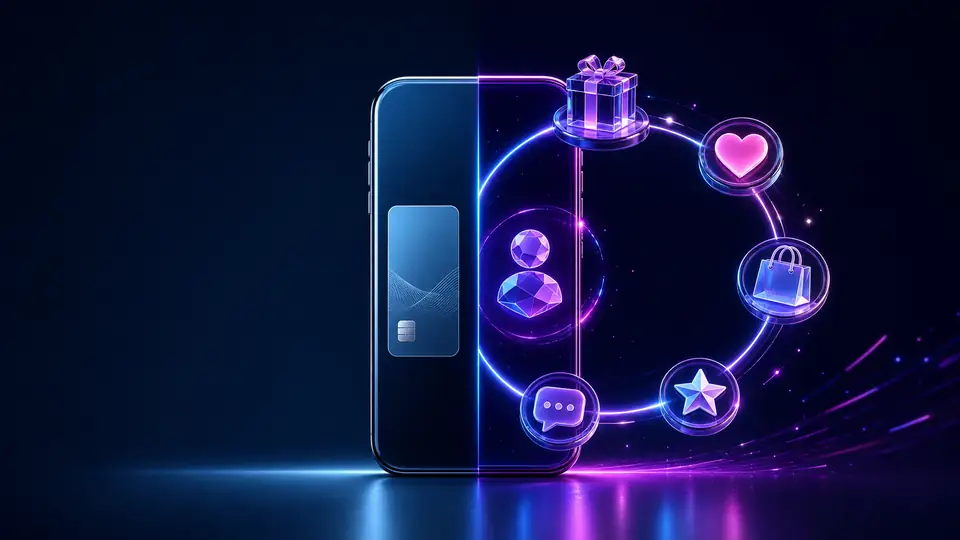
A shared app actually attacks the fragmentation instead of shuffling it around. LoyalsClub is one app across every participating brand: downloaded once, every business is already inside it. The download - the wallet pass's whole reason to exist - gets paid for a single time, ever, instead of once per business forever. You take the "ugh, another app" hit once, and then it works in your favour as more businesses join.
And notice which model the giants actually chose. Starbucks didn't drop its loyalty into a wallet pass - it built an app. So did Sephora. Here in the UAE, Alshaya built Aura: one app across 70-plus brands, from Mothercare to The Cheesecake Factory. When a company lives or dies on customers coming back, it builds the app - never the barcode - because it wants the brand, the data, and the relationship. The only catch is the invoice: an app like that costs a fortune to build and a full-time team to keep running. That's the part a single salon or café was never going to afford - and it's the entire reason LoyalsClub exists. One shared app hands an independent business the Starbucks-style relationship without the Starbucks-style budget.
Three things an app carries that a barcode can't
Beyond the clutter, a wallet pass is limited by what it fundamentally is: a static card with a barcode and a few lines of text. An app is a surface you can build on. Three differences matter for a business built on people coming back:
1. It shows your brand (a barcode doesn't)
A wallet pass gives you a logo, a colour, and a stamp count. That's the ceiling. An app gives you reward photos, offers, and your own page - your brand looking like your brand. Inside LoyalsClub you get a real business page: your story and photos, links to your Instagram and Facebook, and your locations with tap-to-navigate directions. So the same screen that holds a client's points also sends them to your feed and to your door. For a salon, a spa, an aesthetic clinic, presentation isn't a nice-to-have, it's the product. You spent years making your space beautiful; a grey barcode is a strange place to stop caring.
2. It listens
The pass itself is a one-way street: it counts, and that's it. Some pass platforms bolt on a feedback form or link, which is worth asking about. An app can ask in the same place the client checks their points. Private post-visit feedback means an unhappy client tells you - quietly, today - instead of telling Google, publicly, at 4.2 stars forever. That protects the rating that decides your next customer, and hands you an early warning. (More on that leak in why clients don't come back.)
3. It can show you who's leaving
This one is less clear-cut than it sounds, so let's be fair. The pass in your client's wallet only logs a stamp, but the platforms behind passes come with an owner dashboard too, and some add customer segments, push messages and feedback forms. What matters is whether your tool shows you who's returning, who's drifting away, and what they spend - the difference between recording loyalty and managing it. Ask any vendor, including us, to show you that screen before you buy. If your real problem is first-timers not coming back for a second visit - and replacing them costs several times more than keeping them - you don't need a prettier card. You need to see the leak and do something about it. That's a dashboard, not a barcode. (We walk through judging tools by exactly this test - not by feature count - in the salon loyalty apps buyer's guide.)
The honest side-by-side
| Apple/Google Wallet pass | Shared loyalty app | |
|---|---|---|
| First-time sign-up | One tap, no download - the clear winner | One download, then instant everywhere |
| After business #10 | A pass per business - wallet graveyard | One app holds them all |
| Your brand | Logo, colour, stamp count | Reward photos, offers, storefront |
| Feedback | Not on the pass itself | Private, before it hits Google |
| Who's leaving | Depends on the platform's dashboard; ask to see it | Last visit per client, colour-coded, sortable |
| Clients who refuse downloads | Clear winner | Some will say no; staff have to ask |
| Best when | Simple points, lowest friction | You want to see and fix retention |
So which do you actually pick?
Match the tool to the job, not to the hype:
- Wallet pass if your need is genuinely simple points-on-spend, you value the effortless join above all else, and you don't need feedback, visuals, or return-visit data. A single shop that just wants a frictionless stamp card is well served - and shouldn't pay for anything more.
- App if the thing keeping you up at night is what happens after the first visit - seeing who's leaving, protecting your rating, showing your brand properly, and turning first-timers into regulars on purpose instead of by luck.
LoyalsClub is deliberately the second kind. We chose an app because retention is a relationship, not a barcode - and because a shared app is the one design that answers the "not another app" complaint instead of dodging it. Customers download once; every LoyalsClub business is already inside. You get the branded screen, the private feedback, and the who's-leaving data that a static pass simply has no room to hold.
If that's the job you're hiring loyalty to do, see how it works or request a spot. And go clear out your own wallet - those 2023 boarding passes aren't coming back.